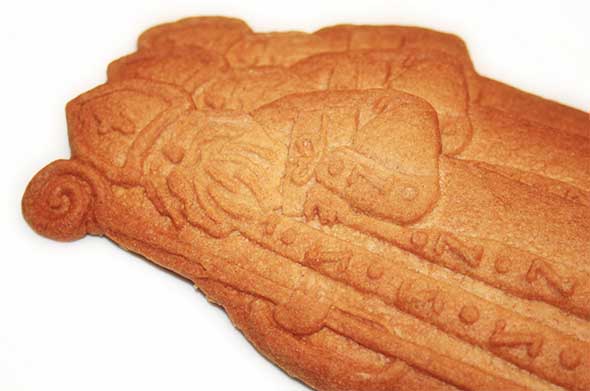
December 5 is one of the most precious days in the Netherlands, the day when Dutch children receive gifts from Sinterklaas (Saint Nicholas), dressed in red and with a white beard, who arrives from Spain in mid-November with his ship laden with presents, to be distributed on his birthday. The celebration is associated with traditional sweets and cookies such as chocolate letters, pepernoten (spicy morsels) and speculaas.
The name “speculaas” is derived from the Latin word “speculum”, meaning “mirror”. This may seem confusing at first, as there is no obvious connection between a mirror and a spiced cookie. However, the explanation lies in the original form and function of the cookie. In the Middle Ages,
The first spiced cookies appeared in Europe when exotic spices such as cinnamon, nutmeg, cloves and pepper became accessible via trade routes. These spices were rare and expensive, so these cookies were often reserved for special occasions.
As spices became less expensive, speculaas spread across all social classes. Regional variations developed: Dutch cookies were generally spicier, while Belgian speculoos evolved towards a slightly sweeter, more caramelized flavor.
See recipe: https: //lacuisinedebernard.com/les-speculoos-moules-saint-nicolas/
Erika grew up in Kansas, USA. Trained in music at Prague and Emory University, she earned a Master of Divinity (Yale, 2007) and then a PhD in the history of Christianity (Boston, 2016). After serving in seven Methodist parishes in the United States, she was pastor of the Evangelical Methodist Church in Lausanne (2015-2022), before helping to create Village Mosaïque.